
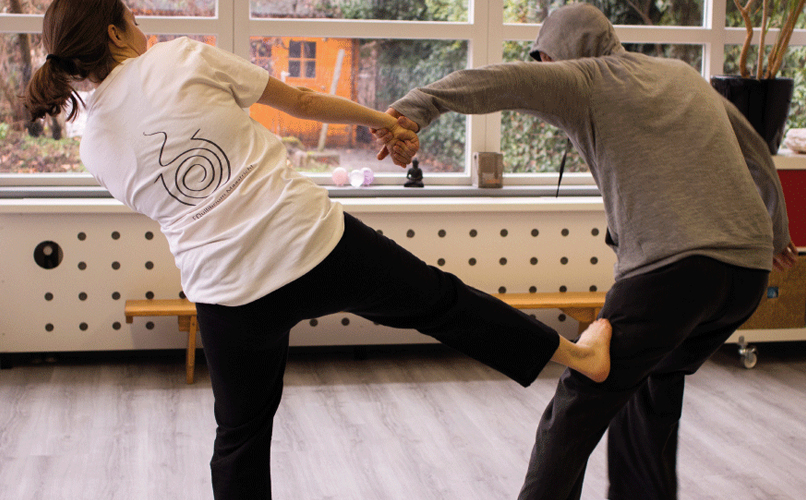
What Real Self-Defense Actually Looks Like Under Stress
Most people learn self-defense in environments that are controlled by design. Timing is predictable, distance is managed, and cooperation is built into the exercise so techniques can be completed cleanly. That structure is useful for learning movement, but it does not represent how real situations behave.
When pressure enters the picture, the body stops operating with the same precision. Breathing changes, visual focus narrows, and decision speed becomes uneven. What looked smooth in training becomes less stable when the nervous system shifts into a defensive state.
This is where expectation and reality begin to separate. Real situations do not allow time for clean execution. They compress decision-making into shorter cycles where clarity is reduced, and movement is less controlled.
Why complex techniques fail when pressure is high
Complex responses depend on sequencing. One action leads into another, often requiring timing, balance, and coordination to stay aligned. Under stress, those elements become unreliable.
As pressure increases, fine motor control decreases. Small, precise adjustments are harder to maintain. The more steps a response requires, the more opportunities there are for disruption.
This does not mean advanced training is useless. It means reliability changes when conditions are no longer stable. What works in a controlled setting does not always transfer cleanly into a chaotic one.
Adrenaline and the delay in decision-making
Adrenaline changes how information is processed. It is not just a feeling of intensity. It alters the timing between recognition and action.
Common effects include:
- Slower recognition of what is actually happening
- Difficulty sorting priorities quickly
- Short hesitation followed by abrupt reaction
- Reduced ability to shift between options once committed
The challenge in self-defense is rarely physical strength. It is the gap between recognizing a situation and acting on it with enough speed to remain in control of outcomes.
Simplicity holds up when conditions break down.
Under unstable conditions, simpler responses tend to remain available longer. They require fewer steps, less coordination, and less precise timing.
This is not about reducing skill. It is about increasing reliability when the body is under pressure. Movements that depend on fewer transitions are less likely to fail when attention and coordination are compromised.
The focus shifts from executing perfect technique to maintaining a usable response under disruption. Consistency becomes more important than complexity.
Escape changes the entire structure of the response
A common misunderstanding in self-defense is the assumption that engagement is the goal. In real environments, prolonged engagement increases exposure and reduces control over what happens next.
A more functional approach prioritizes separation. The objective is to create enough space to disengage and exit the situation.
This shifts decision priorities:
- Movement takes priority over exchange
- Separation takes priority over control
- Exit opportunities take priority over confrontation
Once this shift is understood, self-defense stops being about winning an interaction and becomes about reducing time spent in high-risk proximity.
Reality-based self-defense as a functional system
Self-defense in real conditions is defined by how well someone performs when clarity is reduced. Stress removes precision. Adrenaline disrupts timing. Decision-making becomes compressed.
A reality-based approach accepts these constraints from the beginning. It does not assume ideal conditions. It builds around what remains functional when conditions are not stable.
The measure of effectiveness is not how many techniques are known. It is how consistently action can be taken when control is partially disrupted.